
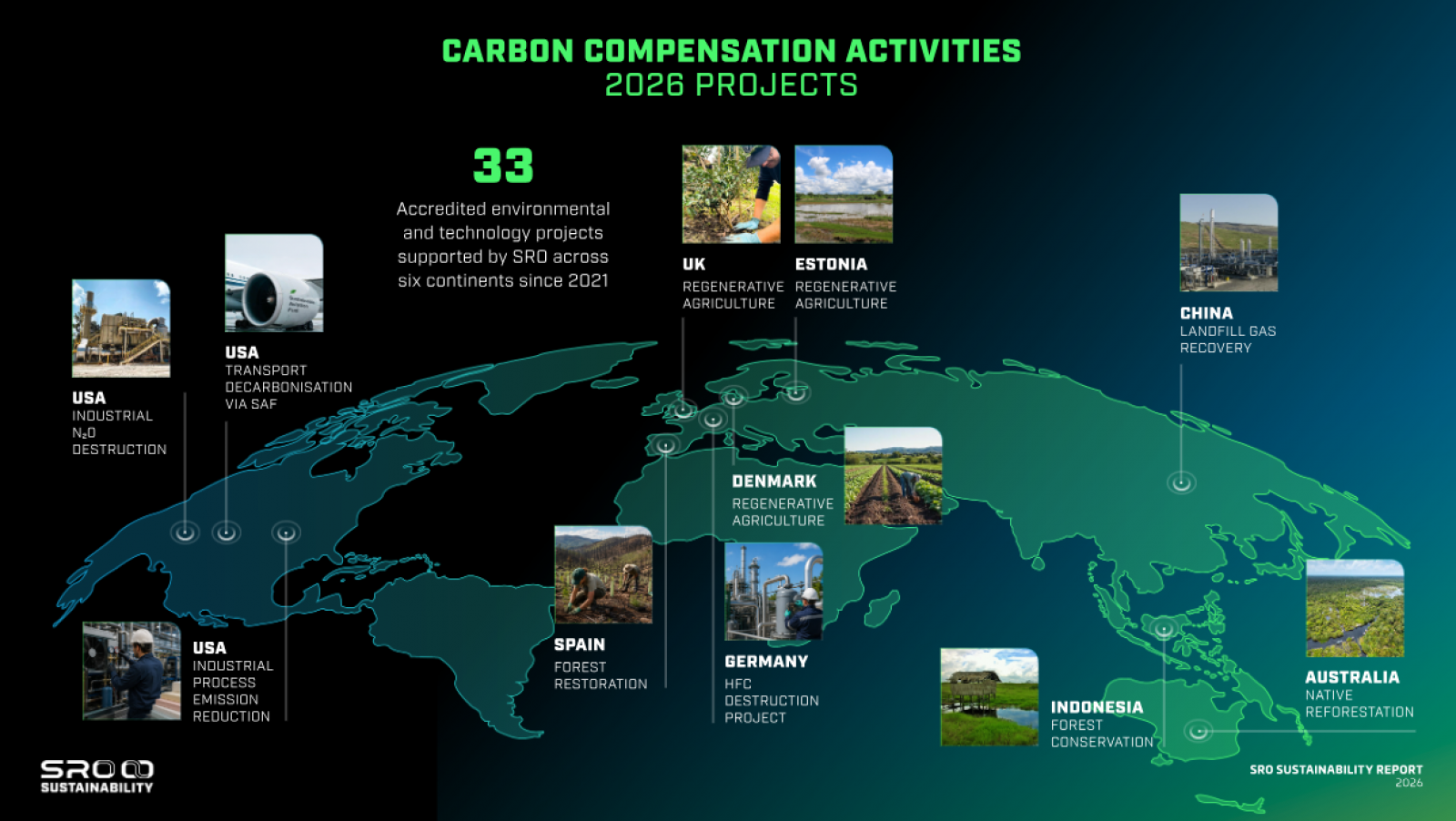
SRO Motorsports Group has reaffirmed its longstanding environmental commitment in 2026 by supporting a diverse range of global projects that reflect its drive for sustainability in racing and beyond. Operating at 100 percent carbon neutrality since 2024, the company remains focused on mitigating its own environmental impact while empowering competitors, partners, and stakeholders to do the same.
Recent initiatives backed by SRO span nature and technology-based projects across multiple continents, aligning with its global racing footprint. Among the nature-based initiatives, SRO has lent its support to the Yarra Yarra Biodiversity Project, a large-scale native reforestation effort in Western Australia that transforms degraded agricultural land into a long-term biodiversity corridor. SRO has significant presence in Australia, notably through its regional GT World Challenge and GT4 series.
In Europe, SRO has backed the AgreenaCarbon Project across seven nations. This list includes the United Kingdom, where British GT represents a key SRO property. The initiative helps farmers move to sustainable land management, reducing agricultural emissions while maintaining farm viability. In Spain, the Sobrado Project is restoring nearly 75 hectares of forest affected by wildfires through replanting, absorbing CO₂ and rebuilding ecosystem resilience.
SRO’s global calendar also aligns with its support in Indonesia, which hosts an annual GT World Challenge Asia event. The Rimba Raya Biodiversity Reserve protects 65,000 hectares of carbon-rich peat-swamp forest and endangered orangutan habitat from palm oil conversion.
The technology-based projects include a significant new development. SRO has expanded its portfolio to include Sustainable Aviation Fuel (SAF) Certificates across the EU and USA, aiding the deployment of lower-carbon fuels. This recognises the impact of team and logistics travel to and from events, which represents SRO’s largest source of emissions.
The United States is home to both a variety of SRO championships, including GT World Challenge and GT4 series, as well as an annual Intercontinental GT Challenge event. Here, the Phlogiston Phase 1 Project funds industrial equipment upgrades to destroy nitrous oxide before it reaches the atmosphere, while the Foam Blowing Agent Project tackles hydrofluorocarbon (HFC) blowing agents.
In China, which hosts GT World Challenge rounds in Beijing and Shanghai as well as the SRO GT Cup, support has been lent to the Guoyang MSW Landfill Gas Recovery Project, which captures methane and converts it into electricity. Lastly, in Germany, SRO supports the HFC Destruction Project, which captures fluorinated gases and converts them into climate-neutral mineral compounds.
“We are committed to being an industry leader in sustainability,” commented SRO Motorsports Group Founder & CEO Stéphane Ratel. “So, in choosing which projects to champion, we have sought to acknowledge the global nature of our business. Adding our support for Sustainable Aviation Fuel Certificates represent another important development, as it recognises the emissions caused by travel to and from events.
“In 2026, I can say that sustainability is no longer a special project, but rather a core aspect of our day-to-day operations. The succession of heatwaves we have experienced this summer is a timely reminder of the importance of sustainability programmes and the need to keep driving meaningful action. Many of our stakeholders feel the same and, as we move forward, I hope that we can encourage even more to join us on this journey.”
Today (16 September) marks the International Day for the Preservation of the Ozone Layer, which was established in 1994 by the United Nations General Assembly to commemorate the 1987 Montreal Protocol on Substances that Deplete the Ozone Layer. Observed annually, it acts as a timely reminder of the need to phase out ozone-damaging substances.
Recognised as the global leader in GT racing, SRO first established its environmental strategy in 2021, balancing the compensation of unavoidable emissions with rigorous carbon reduction efforts. Having achieved 100 percent carbon neutrality in 2024 the company continues to uphold this status through its support of projects around the world, while also reducing its own carbon footprint and minimising emissions across its operations.